
What Is a Delphi Study? Methodology, Tools, Applications, and Analysis
- aliciacarabali
- May 13, 2025
- 3 min read
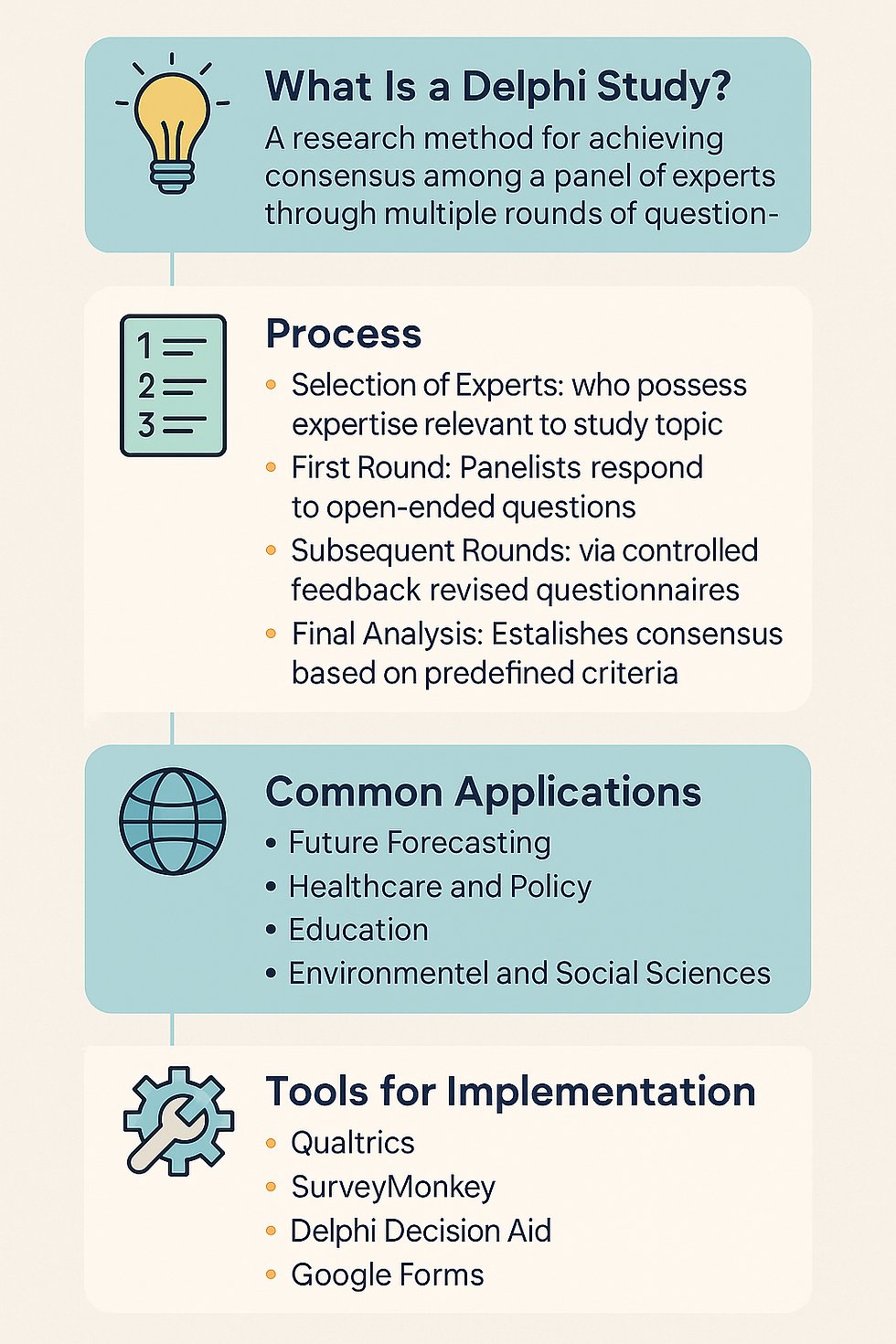
Note: This blog entry is mostly generated by AI
Introduction
In areas where empirical data are lacking or uncertain, decision-makers often rely on expert opinion. But rather than collecting one-off perspectives, researchers turn to systematic methods to refine and converge expert insights. One of the most respected techniques is the Delphi study.
Developed by RAND Corporation in the 1950s for military forecasting, the Delphi method has evolved into a powerful research tool used in diverse fields such as healthcare, education, public policy, and technological foresight.
What Is a Delphi Study?
A Delphi study is a structured, iterative process used to gather judgments from a panel of experts. Its key features include:
Anonymity: Experts do not know who else is on the panel, reducing the influence of dominant individuals.
Iteration: Multiple rounds of questionnaires allow experts to refine their views.
Controlled feedback: Participants receive statistical summaries and anonymized comments from previous rounds.
Statistical group response: Aggregated data guide the search for consensus or key divergence points.
Delphi Study Design and Process
1. Expert Selection
Experts are chosen based on clear criteria such as publications, professional roles, or recognized knowledge in the topic domain. A typical panel size ranges from 10 to 50 members, depending on the scope.
2. Round One: Exploration
This round often uses open-ended questions to identify themes, challenges, or priorities. Researchers analyze these responses using content or thematic analysis to generate structured items for later rounds.
3. Subsequent Rounds: Refinement
Participants rate or rank the synthesized items from earlier rounds using Likert scales or similar formats. Feedback includes:
Mean, median, or mode responses
Standard deviations or interquartile ranges
Qualitative comments
Rounds continue until a predefined level of consensus or stability is achieved, usually after 2 to 4 rounds.
4. Final Synthesis
Researchers interpret the aggregated data, identify consensus points, and present insights or recommendations. Results are often triangulated with literature or policy priorities.
Tools for Implementing Delphi Studies
Modern Delphi studies benefit from online platforms that streamline questionnaire delivery and data collection. Common tools include:
DelphiManager (Cochrane Collaboration): Purpose-built platform for Delphi processes.
SurveyMonkey and Qualtrics: Flexible survey tools that support iteration and branching logic.
LimeSurvey: Open-source survey software with strong customization features.
Google Forms: Useful for simple implementations, though limited in automation.
Doodle/GroupMap: Can facilitate real-time feedback in modified Delphi formats.
For collaborative feedback and data synthesis, researchers often integrate:
Excel or SPSS: For statistical aggregation and consensus analysis.
NVivo or MAXQDA: For qualitative analysis of open-ended responses.
Methods of Data Analysis in Delphi Studies
Quantitative Analysis
Descriptive Statistics: Mean, median, mode, and standard deviation are used to assess central tendencies and variation.
Consensus Measures:
Interquartile range (IQR): Smaller IQRs suggest stronger agreement.
Kendall’s W or coefficient of concordance: Measures agreement among raters.
Percentage agreement or threshold values (e.g., 75% rating an item as 4 or 5 on a 5-point scale).
Qualitative Analysis
Thematic Coding: Open-ended responses are coded and categorized.
Content Analysis: Frequencies and themes are quantified.
Iterative Refinement: Emerging themes are transformed into structured items.
Mixed-methods approaches often combine both analyses to enhance validity and richness of results.
Common Applications of Delphi Studies
1. Healthcare
Clinical practice guidelines
Priority-setting in research
Health policy evaluation
2. Education
Curriculum development
Identification of essential skills or competencies
Educational technology forecasting
3. Technology and Innovation
Foresight studies
Horizon scanning
AI and emerging tech governance
4. Public Policy
Risk assessment and scenario planning
Environmental governance
Participatory decision-making
Strengths and Limitations
Strengths
Facilitates consensus in complex or uncertain areas
Balances anonymity with structured collaboration
Adaptable to diverse topics and contexts
Limitations
Time-consuming, especially with multiple rounds
Risk of superficial consensus if analysis is weak
Requires skilled facilitation and clear criteria for expert inclusion
Conclusion
The Delphi study remains a gold standard for structured expert consultation. As uncertainty increases in many domains—climate change, AI, global health—the need for informed consensus grows. With robust design, appropriate tools, and sound analysis, Delphi studies can offer actionable insight grounded in expert judgment.

Comments